
Take it to the Track: High-Performance Driving for Porsche GT Car Owners
Most Porsche owners daydream about unleashing their machines on a real circuit—with no speed limits and no traffic… just the car, the driver, and the track. But very few ever move beyond the fantasy.

This article is your bridge from dreaming to doing. It shows you exactly how to prepare yourself for open track days and lays out the mindset and technique required to run a GT car at speed the right way—maximizing performance while keeping both you and your machine out of trouble.
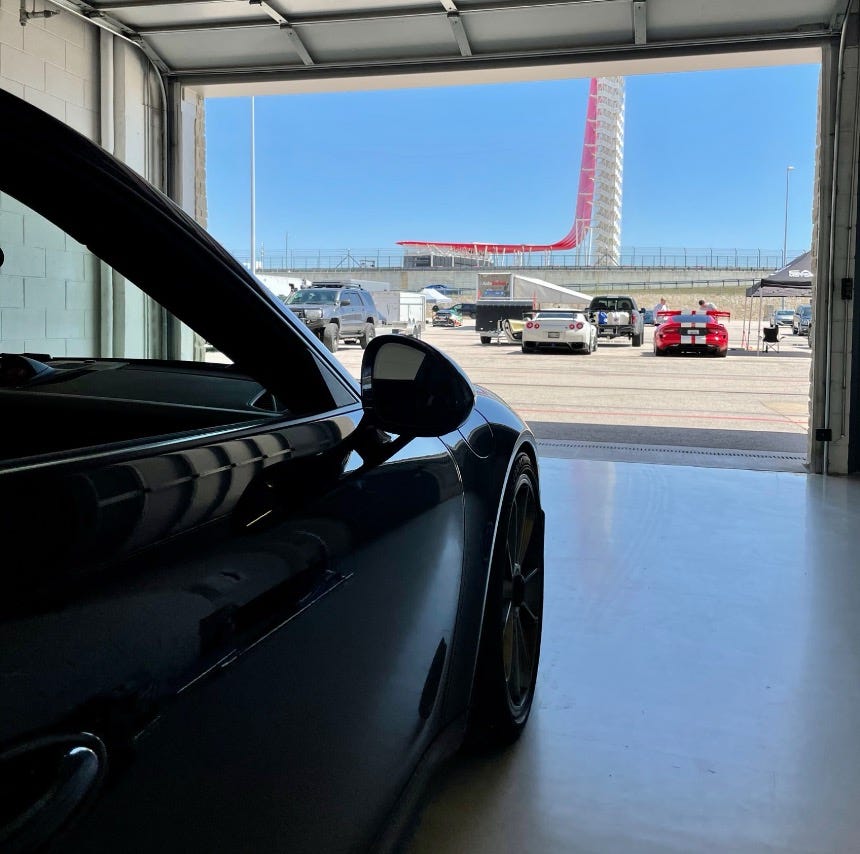
Photo Credit: GT Driven, 2021
Preparing Yourself — Where the Journey Begins
Before you even roll the car out of the garage, understand this: the driver is almost always the weakest link. Porsche of GT cars are immensely capable. They feel planted, composed, and confident at speeds that would terrify drivers of lesser cars. They can also cover up your mistakes on track—up to a point. But if you arrive thinking your canyon driving skills make you a natural, the track will correct you quickly and unapologetically.
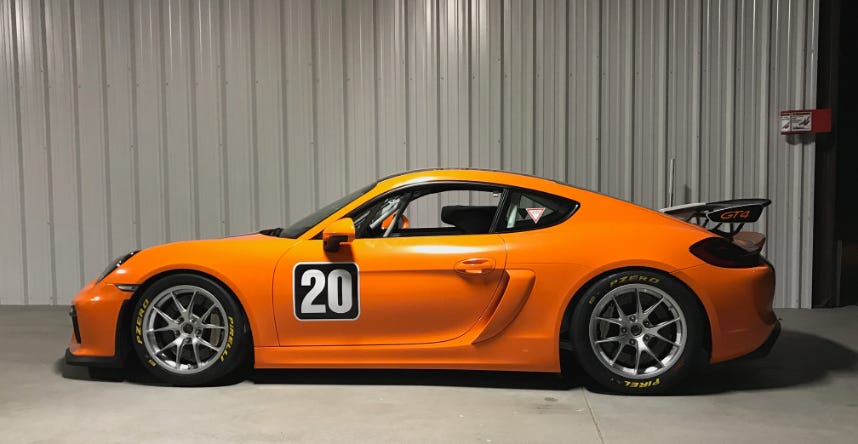
Photo Credit: GT Driven, 2016
The electronic nannies incorporated in all generations since the 996 compound the problem. These tools can mask small- and medium-sized errors in driver inputs. Under normal conditions, they can make you feel invincible—like Kevin Estre’s long lost brother. But once the laws of physics are exceeded, there is no turning back.
Taking to the track for the first time demands a different mindset—one focused on learning, not proving. The drivers who improve the fastest are the ones who show up humble, listen, ask questions, and treat instruction as a gift rather than an insult. Those who don’t often end up discouraged or worse—stuck in the gravel or stuffed into a wall.
Once you focus on learning rather than performing, a GT car becomes your partner instead of your judge. Lap times only matter when used as an objective measure of improvement as you gain experience. What matters most is seat time and the refinement of your technique participate in more track days.
Your First Track Day — Where a GT Car Teaches You Respect
The first track day is when you finally begin to realize what your car is truly capable of. As you begin to work your way up to speed, straightaways shrink, braking zones collapse, corners fire at you with a speed your brain struggles to parse.
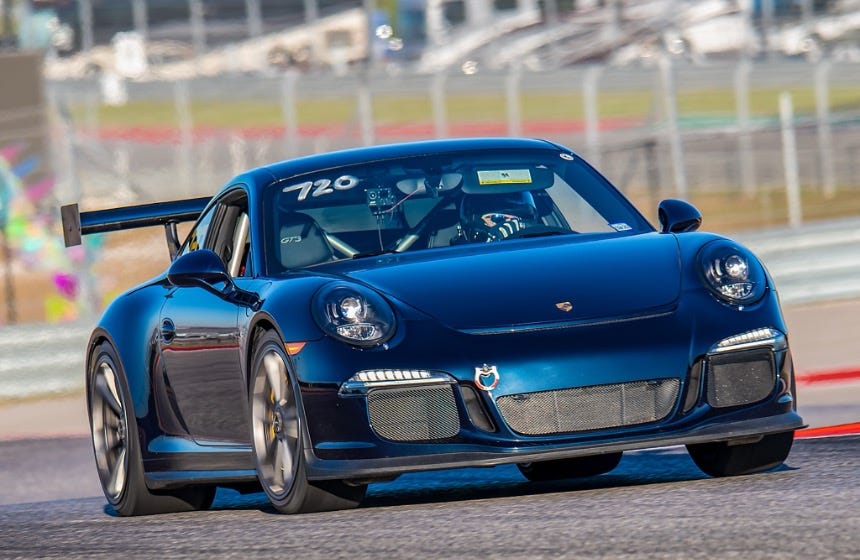
Photo Credit: David Gillen, 2021
Here are a few track hacks you can use to make the day go more smoothly.
A track tour—either walking/biking the circuit or riding with an instructor—can shrink the learning curve dramatically. If you can, grab a copy of the track map and take note of how the track flows. Notice how the line bends, where grip lives, where sightlines disappear. Take written notes to solidify these clues into your mindset. Visualization can also help between sessions. Close your eyes and imagine how you want to drive the line next time your run group is up.
Once you’re on track, the most important rule still feels like ancient wisdom: look far ahead. As far ahead as you can. A GT car compresses time; if you are looking at just what’s immediately in front of the car, it’s already too late. By the time something happens, you’ll be reacting rather than planning ahead. Look at least one full corner ahead. Better yet, look two or three corners ahead if you can.
Smoothness* is your currency. A smooth car reacts predictably and is generally faster. Abrupt inputs in a GT car may be punished instantly if weight is transferred haphazardly from one end of the car to the other. (There’s more on the topic of weight transfer later in the article.)
*Full disclosure: there are two ways to visualize smoothness—inside the car and outside the car. For those that are new to the track, I recommend making everything look smooth inside the car. By that I mean, move the wheel gently and in smaller increments. Press on the brake and accelerator pedals gradually and progressively. As for outside of the car smoothness, that takes things to another level. The basic idea is to ensure that, from the perspective of someone outside the car, everything looks smooth. But what’s happening inside the car may look quite different as you more aggressively apply the controls to stay on the optimal line at the edge of adhesion. Do not do this until you have a lot of seat time!
The Racing Line – Where Speed and Safety Intersect
A good line lets you carry more throttle for longer, reduces steering angle, and provides an extra margin of safety at corner exit. It can also improve tire wear and reduce driver fatigue.
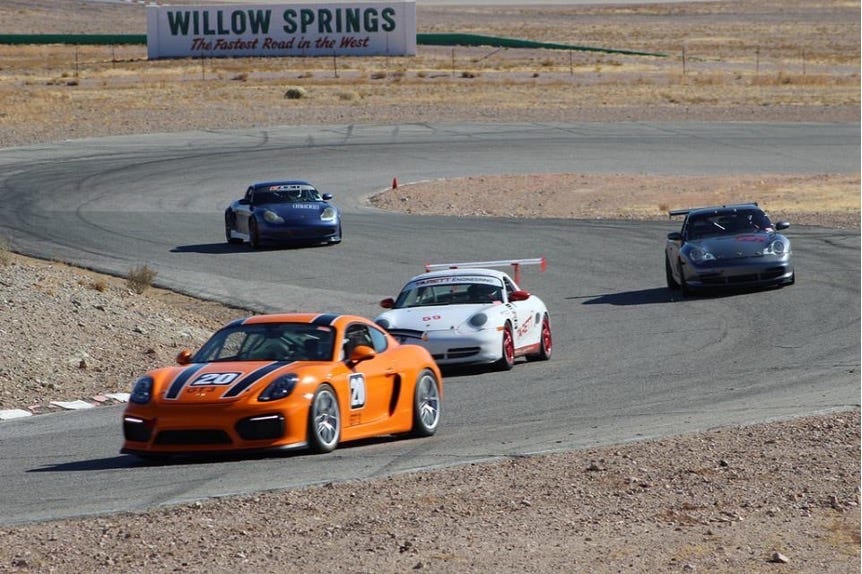
Photo Credit: CaliPhotography, 2016
In GT cars—especially 911s—the line matters even more. While the 911’s rear weight bias increases stability under acceleration, it can decrease stability under braking and during turn in.
A late apex is generally the fastest and safest way around any corner. Combined with a wide entry it’s insurance, giving you the maximum area to unwind the wheel as you gently apply throttle.
Watch how instructors place the car. Feel the timing. Small adjustments produce massive differences in stability and speed.
One rule of thumb I learned in my first racing school is to visualize the steering wheel as though it is connected to the throttle and brake pedals by a string. As you apply more throttle or brake pressure, you must reduce steering input. This visualization works because the tires can take only so much driver input before they lose grip.
Weight Transfer — The Secret Language of GT Cars
Weight transfer is where GT cars stop flattering you and start telling the truth. Every input shifts weight from one corner to another. Brake, and the front digs in. Accelerate, and the rear squats. Turn, and the outside tires shoulder the burden. Combine any two inputs (braking & turning or accelerating & turning) and a skilled driver can subtly move weight front to rear and side to side to aid in acceleration and turn in.
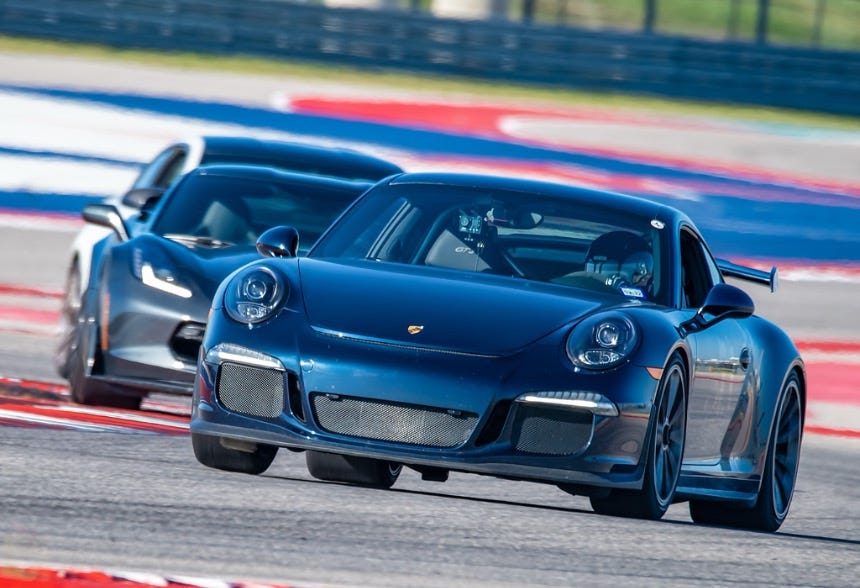
Photo Credit: David Gillen, 2021
Smooth transitions maximize traction. Abrupt transitions overwhelm it. You have a fixed envelope of grip, and every input draws from that budget.
GT cars don’t tolerate overdrawing the grip account. They tell you exactly what you did wrong—and fast.
Oversteer & Understeer — The GT Car’s Uncensored Feedback
Porsche GT cars are engineered to understeer slightly at the limit—to protect drivers from early throttle mistakes. But the combination of rear weight bias and built in understeer can also lead to snap oversteer. (Too much weight transfers to the front tires, and as the driver attempts to compensate by lifting or adding more steering, the rear end comes around like a pendulum.)
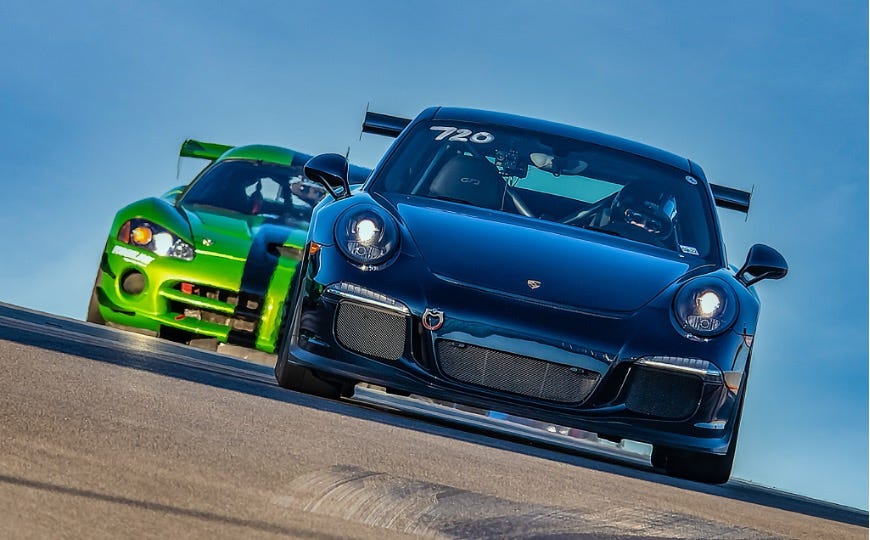
Photo Credit: David Gillen, 2021
While potentially safer, understeer also represents lost potential. It limits the amount of acceleration you can apply on corner exit. On the other hand, excessive oversteer also costs time and is more difficult to control. When the rear steps out, you feel it instantly. But until you get more seat time, it’s difficult to judge the right amount of steering correction. Worse, in an “emergency” situation, a typical driver responds the same way to oversteer and understeer—by lifting off the throttle. Lifting works well in most understeer scenarios. But with oversteer it can lead to a spin.
GT cars generally don’t hide mistakes—not at speed. Instead, they magnify them. But once you learn to read the signals and develop your car control skills, the car becomes predictable, communicative, and deeply rewarding.
In the interim, the TCS and ESC systems in 997 and later generations can be a godsend as you gain more seat time. Do not turn these off until you’ve had time to perfect your technique.
Most of our cars also have adjustable antiroll bars that can be used to fine tune the balance between understeer and oversteer. But I don’t recommend doing that if you are relatively new to the track. Until you gain more experience, it’s difficult to tell whether understeer in a particular corner is due to chassis set up or driver technique.
Advanced Techniques — Trail Braking & Rev Matching
Trail braking separates intermediate drivers from advanced drivers. Rev matching is also essential to ensure smooth transitions under braking and preserve engine life.
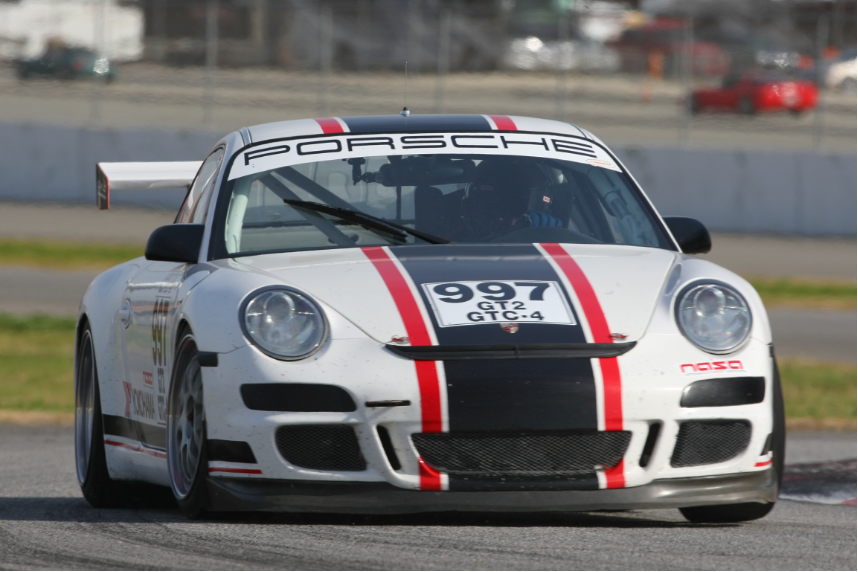
Photo Credit: CaliPhotography, 2011
Trail braking means gently lifting off the brakes as you turn into a corner to transfer weight more progressively and increase grip at the front.
The technique used to be a tricky process in older 911’s. Before the introduction of ABS and traction control, it was more difficult to modulate the brakes while turning into the corner. Push too hard on the brake pedal and you get understeer and flat spotted tires. Lift off the throttle to correct the understeer and the rear end would come around quickly. For that reason, most instructors previously recommended braking only in a straight line, before turn-in. (Many still do. And it’s not a bad idea when you are just getting started.)
But modern GT cars respond well to trail braking—even the 996 sans TCS and ESC.
Rev matching is another important concept to understand when on track. For 996 and 997 GT cars, heel-and-toe technique is the only way to get the job done. Heel-and-toe (moving your foot sideways to blip the throttle with your heel as you brake with your toes) keeps the chassis calm and ties braking and downshifting into one seamless motion. When executed correctly, it feels like a perfect golf swing—effortless and precise. But done wrong you can over rev the engine, forever defiling your DME reading. Worse, you can permanently damage the engine with just one “money shift.”
Matching revs has gotten much simpler with the rev match feature on 991 and later cars. Honestly, I think it’s best to turn on the rev match when learning. There is so much information to process and any signal or technique that can be temporarily postponed will give you more bandwidth to learn the basics. For what it’s worth, all of Porsche’s modern race cars have rev match. And the works drivers use it to reduce mental overload/fatigue and prevent mechanical failures.
Traction Sampling — Feeling the Limit Without Crossing It
The fastest drivers aren’t necessarily the bravest—they just have better feel for the limit. They feel what the tires are doing before a perfect slip angle turns into a slide.
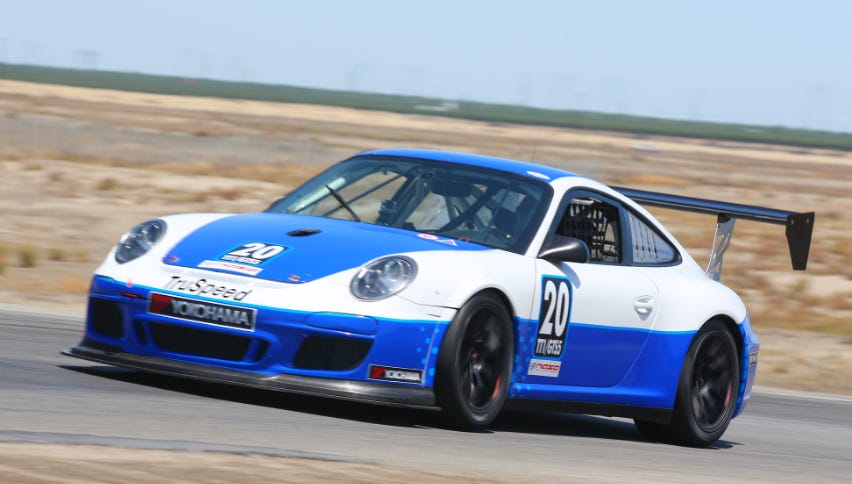
Photo Credit: CaliPhotography, 2014
Traction sampling is the term used to describe how an experienced driver can instinctively sense the grip level on a set of race tires. For an experienced racer, a light scrubbing sensation tells you the car is working. A gentle slip (like when you drag a pencil eraser across paper) lets you know the limit is approaching. Chatter (a choppy tactile feel that occurs before the tires start to make noise) serves as a warning that you just crossed the line and have a fraction of a second to make a correction.
Less experienced drivers generally can’t use traction sampling effectively. Fortunately, that’s often unnecessary with regular street tires. If you are carefully inching closer to the limit as you get more laps in, most street tires will give you an audible warning—a chirp that turns into a screech just before they lose grip completely.
But Cup2 and Cup2R tires are more silent communicators. Yes, they can sometimes make a little noise. But it’s not consistent or predictable. Many drivers also say that Cup2/Cup2R tires don’t work well in colder temps. That’s not entirely true. But lower temps do make it harder to interpret what the tires are trying to communicate. For newer drivers on Cup2/Cup2R tires, my advice is to slowly increase your speed for the first few laps until they warm up on their own terms—then keep them hot. If they aren’t up to temp, they can work against you.
For those who want to master traction sampling faster, autocross is ideal for developing this sensitivity. You will learn it at lower speeds and in an area where there’s nothing to hit other than cones. Once learned, your confidence on track and on the street grows exponentially.
Recommended Track Day Organizations for Porsche GT Owners
Porsche GT cars are best experienced in structured environments. That means finding a well-run organization with experienced support staff, including corner workers and emergency personnel and equipment.
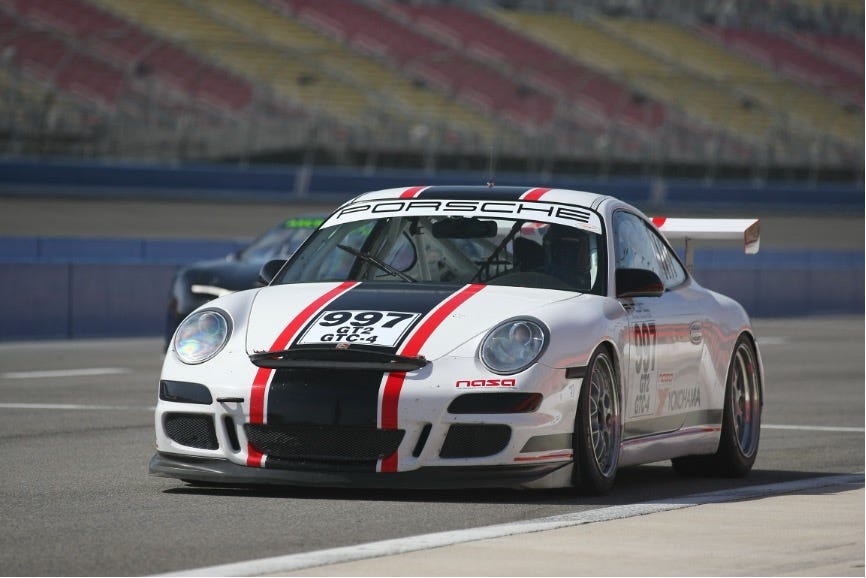
Photo Credit: CaliPhotography, 2011
Here’s a list of some of the organizations that have a long history of producing safe, organized, fun events:
• Porsche Club of America (PCA)
• Porsche Track Experience / Porsche Experience Center
• Speed Ventures / Chin Track Days / Edge Addicts
Each provides different strengths, from instruction quality to run-group discipline. These characteristics can also vary by region, with some regions being better than others. As for the Porsche run experiences, these can be especially pricey. But the instruction is always top notch.
The Thing No One Wants to Think About
High-performance driving isn’t overly dangerous. But it isn’t risk-free either—and your regular auto policy almost certainly won’t cover you once you enter a timed or controlled circuit environment. Many GT-car owners don’t learn that until after something has already gone wrong. Don’t be that guy.
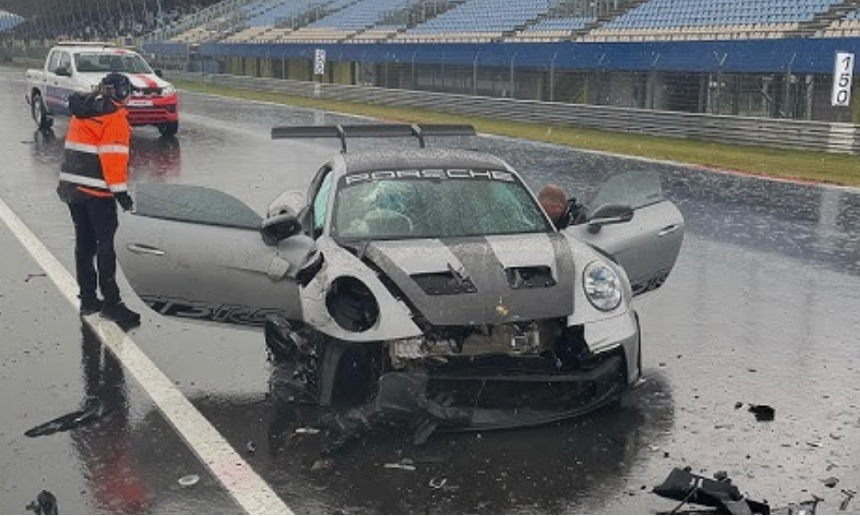
Photo Credit: Carspotter Jeroen on YouTube, 2025
Track insurance exists for a reason. It’s not expensive relative to what’s at stake, and it buys you peace of mind so you can focus on driving instead of calculating repair bills in your head. Companies like Lockton Motorsports and Hagerty offer single-event or multi-event policies specifically designed for track days. Coverage typically includes on-track damage to your own car and sometimes even tow/transport or equipment.
It’s a relatively small price to pay to protect a machine engineered to deliver so much more than you can safely explore on public roads. Track insurance isn’t about fear; it’s about freedom.
Parting Thoughts
Driving a Porsche GT car the way it was meant to be driven isn’t about lap times or bragging rights—it’s about unlocking a level of connection most cars can’t even hint at. Take the time to prepare, learn, and respect the craft, and a GT car rewards you with a clarity of feedback and a rush of speed that borders on addictive. Once you feel one come alive on a real circuit, you’ll wonder why you ever kept it confined to the street.